What Is a Downbeat in Music? Downbeat vs Upbeat and Backbeat
· 5 min read
The downbeat is the first beat of a bar: beat one, the strongest pulse, the place where the music feels like it lands. In 4/4 you count it as the "1" in "1, 2, 3, 4". The upbeat is the beat that leads into it, the backbeat is beats 2 and 4, and the offbeats are the "and"s in between. The table further down lays all four out on a single bar.
If you've ever added a count-in to a backing track and the clicks didn't quite line up with the music, you've run into the downbeat problem. Knowing where the downbeat is, and how to find it, is what makes a count-in actually work.
Try it on your own track, free
What the downbeat is
The downbeat is the first beat of a bar. It's called that because a conductor's baton moves down on it. In 4/4, the most common time signature, the downbeat is beat 1 of every four-beat bar.
When you tap your foot to music, the strongest tap, the one that feels like home, is the downbeat.
Why we call it "one"
Musicians count "1, 2, 3, 4" for a reason. The "1" is where chord changes usually happen, where phrases begin and end, and the point everything else hangs off. It's the beat your body wants to lock to. When a count-in leads into a song, the last click should land right on that "1".
Downbeat vs upbeat, offbeat and backbeat
These four get mixed up constantly, so here they are side by side. Count a bar of 4/4 out loud as "1 and 2 and 3 and 4 and":
- Downbeat: beat 1, the start of the bar. The strongest landing point.
- Upbeat: the beat that leads back into the downbeat, so beat 4 in 4/4 (or the "and" right before the "1"). It's the breath before the drop.
- Offbeats: all the "and"s between the numbered beats. Ska and reggae guitars live here.
- Backbeat: beats 2 and 4, where the snare hits in most pop and rock. Clapping on 2 and 4 means clapping the backbeat. More on where the word comes from and the delayed backbeat in what is a backbeat.
Here is the same bar with each one marked where it falls (musicians write each "and" as &):
| Count | 1 | & | 2 | & | 3 | & | 4 | & |
|---|---|---|---|---|---|---|---|---|
| Downbeat | ● | |||||||
| Backbeat | ● | ● | ||||||
| Offbeats | ● | ● | ● | ● | ||||
| Upbeat | ● |
So in one bar of rock: kick lands on the downbeat, snare cracks the backbeat, hi-hat fills the offbeats, and beat 4 doubles as the upbeat pulling you into the next bar.
Why backing tracks make it tricky
Count-ins often go wrong for one reason: not every song starts on the downbeat.
Plenty of songs have a pickup (also called an anacrusis), notes that come in before the first strong beat. Think of a tune that starts with "and a-one, two..." where the singer comes in before the band hits that first big chord.
A few situations you'll run into:
The song starts on the downbeat. The first sound in the track is the downbeat. Easy, your count-in leads straight into it.
The song has a pickup. There are notes before the downbeat, so the count-in has to end on the real beat one, not on the first sound.
There's silence at the start. Some tracks have a few seconds of nothing before the music. The downbeat isn't at 0:00, it's wherever the music first feels like "one".
The song opens with an ambient intro. Pads, reversed sounds, or noise can come before the actual beat. That's setup, not the downbeat. Your "one" is where the groove kicks in.
How to find the downbeat
It's part listening, part looking.
Listen for the "one"
Play the track and count along: "1, 2, 3, 4, 1, 2, 3, 4". The beat where everything feels grounded, where the bass drops, where the chord changes, where you'd naturally clap, that's your downbeat.
Look at the waveform
In a waveform view like the one in CountIn, the downbeat usually shows up as a strong transient (a sudden spike), the first big drum hit, or the point where the visual pattern starts repeating.
Trust your ear
If you can nod your head to the music, your body already knows where the downbeat is. Go with that.
Why getting it right matters
A count-in that ends on the wrong beat is worse than none at all. Get it wrong and a few things happen.
If the count ends on beat 2 or 3 instead of 1, every click feels off against the music. It confuses you instead of helping. You can also come in with full confidence at the wrong moment, a beat early or late, because you trusted a count that was set up wrong. Do that a few times and you stop trusting count-ins at all, even the good ones.
How CountIn handles it
When you upload a track, CountIn analyzes the audio and suggests where the downbeat is, looking for the first strong transient that marks the start of the music. You see it as an orange marker on the waveform, so you can tell at a glance whether it looks right.
When the auto-detection misses, which happens with pickups and ambient intros, you just drag the marker to the right spot and zoom in if you need to be precise. Then you play the count-in against your track before exporting, so you hear whether the clicks lead in properly.
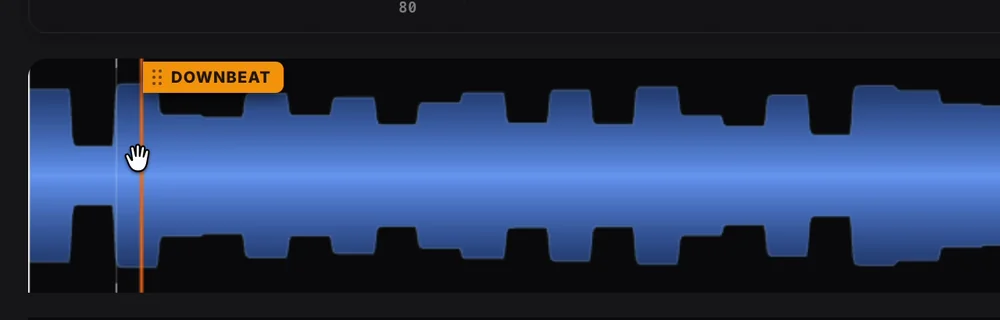
The flag is the handle. Grab it and slide it until it sits on the first beat of the bar.
Tips for tricky tracks
Long intros. Scroll past the intro to where the main groove starts. That's usually your downbeat, not the atmospheric stuff at the top.
Pickups. Listen for where the band lands after the pickup notes. That landing is your downbeat. Put the marker there, not on the first note you hear.
Rubato intros. Some songs play free before locking into tempo. Find where the steady beat begins and use that as your reference, and measure the tempo from there, not from the free intro: tap it out, let the free BPM finder read the file, or see every way to find the BPM.
Odd time signatures. In 3/4, 6/8 and the rest, the idea is the same: beat 1 of the bar. Just make sure your count-in uses the right number of beats per bar.
It gets easier
The more you work with downbeats, the faster you'll spot them. After a few tracks in CountIn, finding the "one" becomes second nature, and you stop guessing when to start. Getting the downbeat right is the foundation of preparing backing tracks for live performance.
Knowing where the "one" is has one obvious use: putting a count-in in front of it. That is a two-minute job on a finished file, and the walkthrough is here: how to add a count-in to any backing track.
Frequently asked questions
What is the difference between a downbeat and an upbeat?
The downbeat is beat one, the first beat of the bar and the strongest one. The upbeat is the beat just before it, the one that leads back into "one". A count of "1, 2, 3, 4" ends on the upbeat and the music lands on the next downbeat.
What are the downbeats in 4/4?
Strictly speaking, each bar of 4/4 has one downbeat: beat 1. You will also hear "downbeats" used loosely for all the numbered beats (1, 2, 3, 4) as opposed to the "and"s between them, especially when someone contrasts playing "on the downbeats" with playing on the offbeats. Both usages are common; the first is the technically correct one.
What is another word for downbeat?
Musicians mostly say "the one" or "beat one". In classical theory the downbeat is called the thesis (and the upbeat the arsis). In conversation, "the top of the bar" points at the same place.
Is the downbeat always the first sound in the song?
No. Songs with a pickup (an anacrusis) start with notes before beat one, and tracks with ambient intros or a few seconds of silence start well before the groove does. The downbeat is where the bar begins, not where the file begins.
Does a count-in have to end on the downbeat?
Yes, that is the whole point of it. The last click sits on the beat before "one", so the music arrives exactly where you expect. If the count ends anywhere else, it works against you.
How do I find the downbeat in a track I did not record?
Play it and count along until the counting feels natural, then look at the waveform: the downbeat usually shows as a strong transient where the drums or bass land. CountIn marks its best guess for you and you drag the marker if it missed.
What about songs in 3/4 or 6/8?
Same idea, different bar length. The downbeat is still beat one; you just count three or six beats per bar instead of four, and your count-in should use the same number.
Is a downbeat the same as a click track?
No. A downbeat is a beat in the music. A click track is a click running through the whole song for the band's in-ears. See click track vs count-in for where each one belongs.
CountIn detects downbeats and lets you adjust them by eye. Try it free, your audio stays in your browser.
Try it on your own track, free
← Back to Blog · Click track · Free BPM finder · Tap tempo · Key changer